

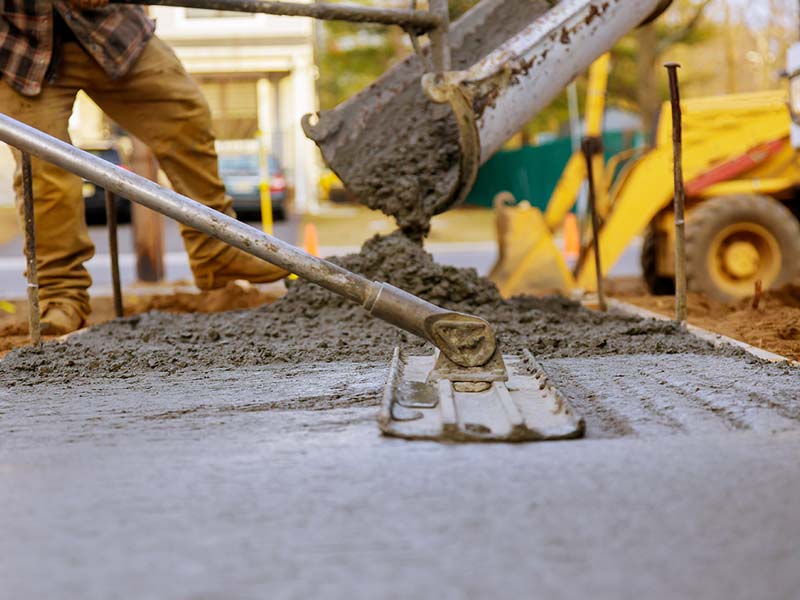
Concrete vs. Asphalt Paving for Commercial Sites: Which Is the Better Investment?
For commercial properties—whether it’s a retail center, office complex, industrial facility, or restaurant—the choice between concrete and asphalt paving goes far beyond aesthetics. It directly impacts maintenance costs, durability under heavy use, customer experience, and long-term return on investment.
While both materials serve the same basic purpose, they perform very differently in high-traffic, revenue-generating environments.
Built for Business: Why the Choice Matters
Commercial sites face unique demands compared to residential projects. Constant vehicle traffic, delivery trucks, heavy equipment, and liability concerns all put pressure on paved surfaces. A poor material choice can lead to frequent repairs, operational disruptions, and even safety risks.
That’s why understanding how concrete and asphalt behave in commercial settings is critical.
Durability Under Heavy Loads
In commercial environments, strength is non-negotiable.
Concrete paving is known for its rigidity and load-bearing capacity. It performs exceptionally well in areas with heavy truck traffic, such as loading docks, distribution centers, and industrial yards. It resists rutting and deformation, even under sustained weight.
Asphalt paving, while durable, is more flexible. This flexibility helps prevent cracking in certain climates, but under constant heavy loads, it can develop ruts, dips, and surface wear more quickly—especially in high-traffic lanes or tight turning areas.
Bottom line: For businesses expecting heavy-duty use, concrete often delivers superior long-term performance.
Maintenance and Operational Disruption
Every repair on a commercial property has a cost—not just in dollars, but in downtime.
Concrete requires relatively minimal maintenance. While cracks can occur, they are typically less frequent and slower to develop. This means fewer interruptions to daily business operations.
Asphalt, however, demands ongoing upkeep. Sealcoating every few years, crack filling, and resurfacing are necessary to maintain performance. While these repairs are usually quicker and cheaper than concrete repairs, they happen more often—leading to repeated disruptions.
Bottom line: Asphalt is easier to fix, but concrete needs fixing far less often.
Lifespan and Long-Term Value
For business owners, the real question isn’t just “What does it cost now?” but “What will it cost over time?”
- Concrete paving can last 30–40 years or more when properly installed and maintained.
- Asphalt paving typically lasts 15–25 years, depending on traffic and maintenance.
Although concrete has a higher upfront cost, its longevity often results in a lower total cost of ownership over the life of the pavement.
Bottom line: Concrete is a long-term investment; asphalt is a shorter-term solution.
Appearance and Brand Perception
First impressions matter in business, and your pavement is often the first thing customers see.
- Concrete offers a clean, bright, and professional look. It can also be customized with finishes, textures, or decorative elements, making it ideal for upscale retail or hospitality environments.
- Asphalt provides a smooth, dark finish that looks sharp initially but tends to fade and show wear more quickly without regular maintenance.
Bottom line: Concrete generally maintains a more polished appearance over time.
Climate Considerations
Location plays a role in performance.
- Concrete performs well in hot climates and resists softening under high temperatures—making it a strong choice in places like South Florida.
- Asphalt can soften in extreme heat, leading to surface deformation under heavy loads.
However, asphalt’s flexibility can be beneficial in colder regions with freeze-thaw cycles, where rigid concrete may be more prone to cracking.
Bottom line: In warm, high-heat environments, concrete often has the edge.
Installation Time and Business Impact
Time is money, especially when construction affects access to your business.
- Asphalt is faster to install and can often be ready for traffic within 1–2 days.
- Concrete takes longer to cure, sometimes requiring several days before it can handle full use.
For businesses needing a quick turnaround—such as renovations or urgent repairs—asphalt may be the more practical option.
Bottom line: Asphalt wins on speed; concrete requires more patience upfront.
Which Should Your Business Choose?
There’s no one-size-fits-all answer, but here’s a practical way to think about it:
- Choose concrete if your site involves heavy trucks, long-term ownership, premium aesthetics, or high temperatures.
- Choose asphalt if you need faster installation, lower upfront costs, or expect to renovate or repurpose the property within a shorter timeframe.
Final Thoughts
For commercial properties, paving isn’t just a construction decision—it’s a business decision. The right choice balances upfront cost, long-term durability, maintenance demands, and how your property is perceived by customers and clients.
Concrete and asphalt both have their place, but understanding how each performs in a commercial setting ensures you’re not just paving a surface—you’re investing in the future of your business.
Comments are closed